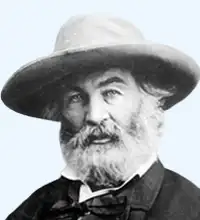
Crossing Brooklyn Ferry is one of the masterpieces in Leaves of Grass. Being a poet, and the voice of the people, Whitman took the role of a prophet and through his poems delivered his message to his people and to the world at large. He took the people with confidence and placed them under the sunshine of modern, healthy and vigorous outlook on life.
He made people realize the reality, and enjoy life to the brim. The poem talks about the brighter aspects of life. It ends on a note of optimism.
“Keep your face always toward the sunshine—and shadows will fall behind you.” ― Walt Whitman (1819-1892)
The poet emphasizes that there is no time limit to the ferrying across the river. People, he says, were thus ferried, they are being ferried every day and they will be ferried thus for ages to come. Anyone familiar with the poems of Whitman will see how the poet tries to establish his identity with the people he sees, then, becomes one with them – one with the milling crowd and enjoys the refreshing breeze of the tides. “The summer sky in the water”, “The scallop-edged waves in the twilight, the ladled cups”, and their experience becomes his. The identification between him and the people or the rapport between him and the reader he thinks aloud: “What is it then between us/Whatever it is, it avails not – distance avails not/and place avails not.”
Though the passengers come together only for a short time as they are ferried across, the poet finds the identification between him and the people who had ferried earlier, who are ferrying and who would also ferry in the future. This identification he elaborates in saying that he also lived in Brooklyn, Manhattan Island and that he also had the blending of opposition in him like: “Had guide anger, lust, hot wishes, I dared not speak/Was wayward, vain, greedy, shallow, sly, cowardly, malignant/Lived the same life with the rest, the same old/Laughing, growing, sleeping.”
All the images of the ferry scene, he catalogues and shows he is like any other human being with the same human passions. Slowly the poet, after referring to the ordinary ferry scene, tries to establish the identity with the others- it may be voyagers; it may be the readers and it may also mean the identification of the soul which later identifies itself with the universal soul. This idea is clearly stated in the lines:
“We understand then do we not/What I promised without mentioning it, have you not accepted?/What the study could not teach—what the /Preaching could not accomplish is/Accomplished, is it not?”
After the direct identification which no books each, the poet re-invokes all the images of the ferry scene of the earlier sections which assisted the poet infusing with the reader, enabling the reader to see an additional meaning in it and persuades him to know the universal identity.
The poem itself is a ferry, shuttling across the river of time. People enjoyed reading his poems. They read this poem, and shared his experience. Even in the future, people would read it and share his experience. In this manner, the poet establishes identification with the reader, transcending time and space.
The poet shows that unity exists in diversity. People from different walks of life ferry unitedly. Everyone is separate yet also an essential part of the unity. All objects in nature and the world look separate, yet there is harmony and unity in them which go to make a “well join’d scheme,” the poet after mentioning a catalogue of scenes and sights, in the last section calls on the countless crowds of passengers to cross the river from shore to shore, calls upon the sea birds to reel and wheel, and the sun-set clouds to drench him with their splendor.
Critical Analysis
The poem is based on Whitman’s ideas on the external forward movement of all things, through life, death and rebirth, and his ideas of an interrelationship of all people that transcends time and place. He reaches back to acknowledge the past and look forward to greet the wonderful future. The ferry, the people that cross on it, and the rushing water beneath, serve for Whitman as mystical symbols of an everlasting and unified flow of humanity from the present into the future.
The scene is of New York harbor and it is a very realistic one. But the poet’s meditations expand it into a timeless locate that is part of a dreamlike vision. Whitman looks ahead from his own time as well as back from a future moment in the company of future people. The busy sights and sounds could be the bustle of any place and any time: their symbolic meaning transcends the harbor and represents the sharing of all life’s experiences. Time and distance never isolate people in the philosophy of Whitman’s poetry; the poet always expresses his belief in a unified chain of humanity, unbroken and extending forward and backward in time. Several images in the poem suggest notions of a life and death cycle. The images with their movement toward sunset suggest the human journey from birth to death and the unity of generations in an endless process. From the great spiritual reservoir the individual is given individuality. The individual possesses ‘individuality’, yet is bound in a unity of common spiritual origin.
Crossing Brooklyn Ferry is a kind of dramatic monologue. The title of the poem introduces the temporal and spatial figures that play such important parts in the poem. The figurative ferry and the equally figurative flood tide carry him “far away” to that purely poetic place from which his highly metaphorical meditation on time and space, doubt and faith, issues. The panorama of the city and the river as seen from the moving ferry gradually comes to coexist with the narrator’s imagined sight of those people of the future who will occupy the place he occupies now. The curiosity of the poet’s eyes extends from the physical the imagined, from the perceptual to the conceptual. The persona crosses from shore to shore, from tangible to intangible, sight to feeling, object to subject, and more importantly, from present to future as Whitman attempts to go beyond the doubts, questions and fragmentation of modern experience caused by various psychological, political, and spiritual uncertainties. He crosses to the future as teacher, prophet, and comrade. He offers the consoling vision of a “well-joined scheme” in which everything and everyone have their part to play, whether “great or small” in the making of a soul that seems to resemble more closely the Hindu ‘atma’ than the individualized Christian spirit. The idea of transcendence is here extended to that of transcending over time to make one’s being connected to those of the people of the future.
The style of Whitman is both minutely particular and broadly general. It involves the merging, or contrasting, of the particular and the general, of private revelation and public declaration, of the self-reliant individual and democracy’s ‘mass man’. This is a poem of his obsession with the democratic poetics. Whitman avoids conventional poetry’s narrowly defined rhythmical patterns and he explores the possibilities of more fluid and organic rhythm based upon repetition of various kinds of words and syntactical structures. Another striking feature of his style is the manipulation of tense. Speaker and reader merge by means of a trick of tense. The future becomes present and present becomes past. But then, becoming free of verb tenses and of psychic tensions, the speaker posits the reality of the eternal moment of time itself or rather of timelessness. Whitman’s transcendentalist narrator penetrates the “appearances” of the world of phenomena in order to discover the truth that binds each and all together in one “simple, compact, well joined scheme.” The scheme is the cosmic design, the house builder’s version of Emerson’s more abstract Over-soul against the exclusion, exile and helplessness of modern man. Whitman holds out the possibility of a slimed experience, a return to the wholeness of the protecting, all-satisfying “solution” of the cosmic womb. The mood throughout the poem is one of joyous celebration. The speaker’s faith is firm, the questions that at first seem to express doubt turn out to be rhetorical. The poem’s meaning lies within the poet’s power of imagination in the realm of the ecstatic and the prophetic.