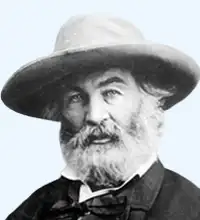
The very beginning of the poem Song of Myself Section I, is characterized by Walt Whitman himself called ‘the vehemence of pride and audacity of freedom necessary to loosen the mind of still to be formed America from the folds, the superstitions, and all the long, tenacious and stifling anti-democratic authorities of Asiatic and European past’.
“’Let your soul stand cool and composed before a million universes.” ― Walt Whitman (1819-1892)
The beginning of this poem establishes the Americanness in its subject, form and tone. Whitman begins the first section in a tone of boastful authority that underlies the tone of the whole poem. The reader is jolted into attention and is attracted towards the poet: “I celebrate myself, and sing myself’. The second line is even more daring and shocking; it gives an impression, at first, that the poet is almost presuming and conceited: “And what I assume, you shall assume”. But then the third line quickly conveys the reason behind the arrogance; the poet is so proud and arrogant because “every atom belonging to me as good belongs to you”. The very third line establishes identity between the reader and the poet. This is, as we will see very soon, a poem that celebrates the basic oneness of all people, the power of their life and freedom, their oneness with the nature also. The poem presents not merely a mind thinking or a voice speaking, but an entire body reclining on the ground, leaning and loafing, “observing a spear of summer grass”. Whitman situates himself and his poem outdoors and outside convention and tradition. Radically democratic and explicitly sexual, the poem, from the very start, goes beyond even the extended bound of transcendentalist thought in its celebration of the relation between physical and spiritual, individual and universal. It is a poem of democracy and liberty, the liberty of expression, of life and even of frank declarations of emotions as well as rebellion and repressed desires including the sensual and sexual. Whitman begins the poem by asserting the idea of self and its identification with all selves, and its identification with all selves and emphasizing his belief in the interrelationship of all beings and all matter. This is the first indication of its theme of unity of all life and nature the inherent transcendence. In the 4th and 5 lines, the poet describes the physical setting; he is leaning, at ease, on a lawn observing a leaf of summer grass.
He then begins another impassioned expression about “my tongue”, which is another symbol of expression (or the democrats, and also poetic, freedom of speech): “My tongue… my blood, formed from this soil…born here from… the same…” He probably means that he, like everyone there, is born from the same soil. He therefore will begin to express, and “hoping to cease not until death”. This optimism and energy permeate the whole poem. One should remember that Whitman had begun to write this poem after hearing a lecture by Emerson in which he had “called for an authentic American culture to celebrate the common, everyday things in American life”. The next daring declaration is: “I harbor for good or bad, I permit to speak at every hazard/ Nature without check, with original energy”. Here nature means the actual human nature as well as the physical nature. These two lines define the poem, more than any critical phrases could. Whitman reaffirms his belief in the essential integrity and goodness of all act, sensations, and responses. The body is not to be denied, for it is equal to identifiable with the spirit. The poem’s essence is precisely based on the fact that it deals (harbors) with everything, whether it be called good or bad, moral or immoral, by the (restrictive) conventions.
Song of Myself Section Six
By the sixth section, Whitman has established the setting, mood, and tone, and has also introduced the basic themes of the poem. In the 6th section, he adds a typical dimension to the poem’s setting: A child brings a handful of grass and asks him what it is, and he has to go on guessing, puzzled. This section is often read as an independent poem also.
The poet’s pondering upon the grass gives rise to several guesses, in his attempt of interpreting the blade of grass. Though the poet is basically ignorant about the significance of grass, he does make some thematically significant guesses. First, he says that it is so enigmatic and mysterious that he doesn’t know any more than the child does. Indeed, the transcendence and mystical value of grass is never fully knowable. Then he guesses that it must be “a flag of my disposition (temperament); and so it is. It is the emblem (flag) of man’s nature/tendency in terms of existence. Next he guesses that it might be the “handkerchief of the Lord/ A scented gift and remembrancer designedly (intentionally) dropped.. bearing the owner’s name… so that we may see and say Whose?” This guess is even more significant. Handkerchief could be symbolic of a loving gift, a `remembrancer’, as he says, and a signal that the good god is present in the manifestation of the nature’s beautiful things like the grass. Furthermore, the grass is also a thing that draws man’s attention towards nature. The grass, as he guesses next, could also be a child. Or it could be a hieroglyphic, a thing that is not easily readable. It is something that grows among the black folks as among the white; it is the same child, whether it is born among the Kanuck (French-Canadian, whatever origin), a Tuckahoe (Virginian lowlander, whatever region), Congressman (whatever political affiliation), Cuff (Afro-American, whatever color). It then seems to him like the beautiful uncut hair of graves; note that this is connotative of what can conventionally be called vulgar. Then he speaks to the grass, saying that it might have from the breasts of young men, or from old people, or from infants taken early to be buried. The grass might well have grown from the mouth of buried men: this reminds the speaker of the notion of expression. Grass is itself expression; it has “so many uttering tongues”. He wishes that he could translate the hints of those people who died without having the chances to speak. The several guesses about the meaning of grass can be summed up by saying that grass is the symbol of the transcendence of life, because it represents the cycle or the chain of life (living beings come from the nature and go back to nature). It comes as a mediator between the intelligent beings and the material nature, being a ‘living’ ‘thing’. The speaker comes to the conclusion that if life goes on and on in a cycle of beings, mediated by the grass, then: “the smallest sprout shows there is really no death/ And if ever there was it led forward life”.
Indeed, there is death, but it is there just to lead life forward: it leads the collective life of the loving beings forward, for though the individual dies, the chain of being remains. The unity and interrelationship between all things in the world provides a transition for Whitman to his mystical impression of the grass. For Whitman, the grass is not simply a separate and distinct growth but is part of all things. It has an identity with them and represents their unity and transformation from one form to another in a cycle of life, death and rebirth. Whitman’s notion of life and death does not follow the more orthodox religions in which a conscious and purely spiritual existence is lived after a moral life span. Death for him does not represent any break a halting in the flow of life. If matter goes on, then life and the spirit go on. In the idea of reincarnation, there is a sense of continuality and deep satisfaction for the poet. The infinite, eternally sprouting grass is both the symbol of and a functioning part of Whitman’s forward regenerating movement of all life. “All goes onward and outward, nothing collapses, and to die is different from what anyone (has) supposed, and luckier”. This section ends with the affirmation of the transcendence, though the guessing seems to be a product of an unenlightened understanding.
Song of Myself Section Eleven
This section is representative of the frankness and boldness of expression of Whitman’s poetry. This section introduces 28 men seen from the viewpoint of a woman who is confined inside her house and is secretly looking from her window, attracted by the beauty of the young men’s bodies.
This is obviously a defiance of the social restriction (especially on women) against appreciating the body. The nineteenth century America was terribly conservative, and Whitman’s poetry was repulsive for many such reasons. The speaker of the poem is probably looking at the whole scene from a distance, and he pities the woman: “Twenty-eight ears of womanly life and all so lonesome.” The men are not conscious. He even imaginatively speaks to her. The men’s beards shined, and streams of water flowed down their bodies, and “an unseen hand passed over their bodies and it descended tremblingly from their temples and ribs…” The poet is referring to the woman’s desire of caressing the handsome bodies. Modern readers might also guess that the poet is playing with an almost homo-erotic image! From the woman’s viewpoint at least, it is enchanting to see the young men floating ‘on their backs’.
Song of Myself Section Fifty two
There are five or six phases the development of ideas in the poem; the speaker (the unenlightened rough American of section 1) passes through these phases of experience and change. In short, the phases are as follows:
1)The common man, different from others only with his uncommon sense of wonder towards his surrounding and his fellow beings; 2) gradually enters a kind of awakening, mystical experience, experienced awakening, at least in thought; 3) illumination and mystical experience, along with the acceptance of sensuality; 4) the ‘night of the soul’, or the intense suffering due to the realization of the suffering of other human beings, and a spiritual purification; 5) the preparing to leave, after having realized the transcendence of life. From section 51 itself, the cycle of the poem moves towards completion; and section 52 cycle of the poem begins to declare how the speaker takes leave from his human form to enter the great cycle of immortal/eternal life back in the nature as a part of it. He will now become one with the leaf of grass, as common and natural and as undying but ever changing. The poet like each component of the universe has completed a phase of the great evolutionary process. At last he tells the reader he will take just another form and go on living, most likely in the form of grass. There is no “death” for Whitman, no ultimate “dissolution”. He will fuse with the pantheistic “grass”, the symbol of eternal and reincarnating life. The poem ends by having developed the theme of transcendence and also having applied it to the poet’s own case. He is transcending life, and that is why, as we understand now, he was celebrating it in the beginning of the poem.